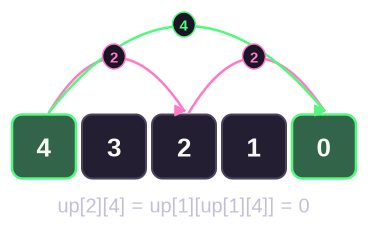
Every binary-lifting trick (k-th ancestor, LCA) starts with one table: up[j][v] is the node 2^j steps up from v. Row 0 is the parent; each later row doubles the one before (2^j steps is 2^(j-1) steps, twice).
You get a rooted forest as parent (-1 for a root; parents needn't have smaller numbers). Implement build_jump_table(parent) -> list[list[int]] returning exactly LOG = n.bit_length() rows of length n:
up[0][v] = parent[v];up[j][v] = up[j-1][ up[j-1][v] ], or-1once the walk runs off the top.
# chain 0 <- 1 <- 2 <- 3 <- 4   (0 is the root)
build_jump_table([-1, 0, 1, 2, 3])
# [[-1, 0, 1, 2, 3],     1 step up
#  [-1, -1, 0, 1, 2],    2 steps up
#  [-1, -1, -1, -1, 0]]  4 steps up
1 <= n <= 10^5; there may be several roots.
⭐ Bonus: a speed test on a 100,000-node chain earns a star if each row is built from the previous one in O(n).
Show hint
build rows in order j = 1, 2, ...; each reads only the row before, so node order doesn't matter.