TreeNode(val, left=None, right=None) is in the starter. Keep it.
In a binary search tree, every value in a node's left subtree is smaller than the node's value and every value in its right subtree is larger, so an in-order walk (left subtree, node, right subtree) meets the values in increasing order. Build a class BSTIterator that hands them out one at a time:
BSTIterator(root)sets up the iterator.rootmay beNone(an empty tree).next()returns the smallest value not handed out yet. It is only called when such a value exists.has_next()returnsTrueif there are values left andFalseotherwise. It doesn't use one up.
#        7
#       / \
#      3   12
#     / \    \
#    1   5    15
it = BSTIterator(root)
it.next()       # 1
it.next()       # 3
it.has_next()   # True
it.next()       # 5
it.next()       # 7
it.next()       # 12
it.has_next()   # True
it.next()       # 15
it.has_next()   # False
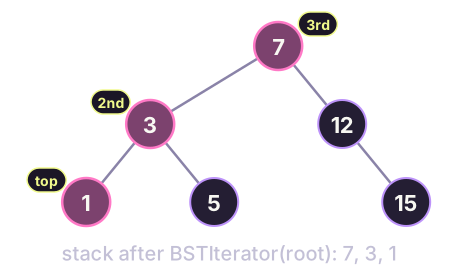
- Up to 131,071 nodes with distinct values. Trees can be up to 2,000 levels deep: if you recurse, raise the limit first (
sys.setrecursionlimit(10_000)). - Flattening the whole tree into a sorted list in the constructor passes. For a better answer, use O(h) memory, where h is the tree's height, with
next()andhas_next()taking O(1) time on average.
⭐ Bonus: a speed test that walks a 131,071-node tree earns a star when each call takes O(1) time on average. Redoing an in-order walk on every call is too slow.
Show hint
Keep a stack of nodes that are still waiting. To start, push the root and keep going left, pushing every node. next() pops the top node (the smallest left), then pushes its right child and that child's whole left edge.