A drawing app lets users drop pins on a grid, and it wants to suggest squares. Build a class PointBoard:
PointBoard()starts with no points.add(x, y)places a point at(x, y). The same position can be added several times; each copy is a separate point.count(x, y) -> intreturns how many ways you can pick three stored points that, together with the query point(x, y), form the four corners of a square with sides parallel to the axes and positive area. Using a different copy of a repeated point counts as a different way. The query point itself is not stored.
board = PointBoard()
board.add(2, 2)
board.add(2, 6)
board.add(6, 2)
board.count(6, 6)   # 1   (corners (2,2), (2,6), (6,2) and the query (6,6))
board.count(2, 4)   # 0
board.add(6, 2)     # a second copy of (6, 2)
board.count(6, 6)   # 2   (either copy of (6, 2) can be used)
board.add(10, 2)
board.add(10, 6)
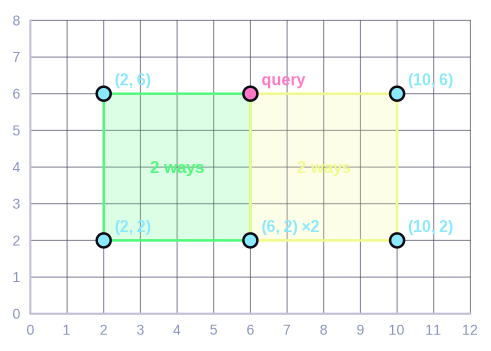
board.count(6, 6)   # 4   (the left square in 2 ways, and the square with (10,2), (10,6), (6,2) in 2 ways)
Constraints:
0 <= x, y <= 10^4.- At most
10^5calls in total. Answers can exceed2^31.
⭐ Bonus: looping over every stored point on each count still passes; a speed test earns a star with add in O(1) and count proportional to the number of distinct stored positions sharing the query's x.
Show hint
Keep a tally of how many copies sit at each position, and also group positions by their x. Any square through (x, y) has a corner directly above or below it; that corner fixes the side length, and the other two corners are then determined.