Level 1 Fewest encrypt commands
A storage team must bring a file tree into a required encryption state. The tree is given with these classes (they are in the starter; keep them in your solution):
@dataclass
class FileNode:
    name: str
    is_encrypted: bool                 # the REQUIRED final state of this file

@dataclass
class DirectoryNode:
    name: str
    directories: list["DirectoryNode"] = field(default_factory=list)   # child directories
    files: list[FileNode] = field(default_factory=list)                # files directly inside
Right now every file is unencrypted. The only tool is encrypt(target), where target is either a single file or a directory; encrypting a directory encrypts every file anywhere below it. There is no way to decrypt, so you must never encrypt a file whose is_encrypted is False.
Write min_encrypt_operations(root: DirectoryNode) -> int: the smallest number of encrypt calls that leaves exactly the files marked is_encrypted=True encrypted.
- A directory can be encrypted in one call only if every file below it must be encrypted. A directory with no files anywhere below it gains nothing from a call.
- The root itself may be a target.
F = FileNode
D = DirectoryNode
root = D("/", [
    D("photos", [D("2023", [], [F("a.jpg", True), F("b.jpg", True)])], [F("c.jpg", True)]),
    D("docs", [], [F("cv.pdf", True), F("notes.txt", False), F("tax.pdf", True)]),
    D("empty"),
], [F("readme", False)])
min_encrypt_operations(root)   # 3: encrypt photos, cv.pdf and tax.pdf
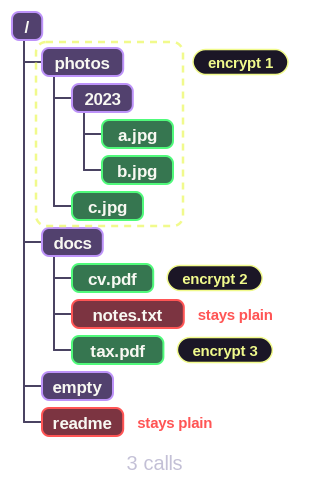
Constraints: up to 10^5 directories and files in total.
⭐ Bonus: a speed test with directories nested 5,000 levels deep (too deep for plain recursion in Python) earns a star in O(n). Recomputing "is everything below this directory encrypted?" for every directory is the classic slow approach.
Show hint
one post-order pass. For each directory compute two things from its children: whether it has any file below it with every such file needing encryption ("fully encrypted"), and the best cost for its subtree. A fully encrypted directory costs 1; otherwise it costs the sum over its child directories plus its own files that need encryption. Use an explicit stack for the post-order.