A town has intersections 0 .. n-1 joined by two-way streets (a, b, minutes). Tonight only the pharmacies at the intersections in open_at are open.
Implement nearest_pharmacy(n, streets, open_at) -> list[int]: element v is the shortest walk from v to any open pharmacy (0 if v has one), or -1 if none can be reached.
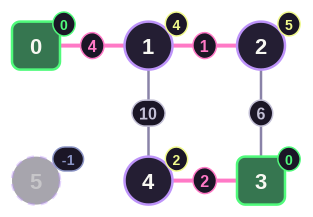
streets = [(0, 1, 4), (1, 2, 1), (2, 3, 6), (3, 4, 2), (1, 4, 10)]
nearest_pharmacy(6, streets, [0, 3])
# [0, 4, 5, 0, 2, -1]     node 2: via 1 to 0 is 5, direct to 3 is 6; node 5 is isolated
Up to 10^5 intersections and 2 * 10^5 streets. open_at may be empty or repeat an intersection.
⭐ Bonus: a speed test with 5,000 open pharmacies earns a star with one Dijkstra instead of one per pharmacy.
Show hint
put every pharmacy on the heap at distance 0 before you start; the first time a node is settled, its distance is to the nearest one.