A masonry-style feed shows pins in k columns, numbered 0 .. k-1 from left to right. A column's height is the sum of its pins' heights.
Pins arrive in the order of heights, and each one drops into the currently shortest column; on a tie, the leftmost.
Write layout(heights: list[int], k: int) -> list[list[int]]: for each column, the pin indices placed in it, top to bottom.
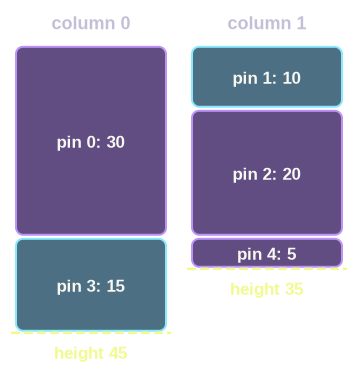
layout([30, 10, 20, 15, 5], 2)   # [[0, 3], [1, 2, 4]]
layout([4, 4, 4], 5)             # [[0], [1], [2], [], []]
layout([], 3)                    # [[], [], []]
Tracing the first call (column heights after each pin):
| pin | height | goes to | heights |
|---|---|---|---|
| 0 | 30 | column 0 (both 0, leftmost wins) | 30, 0 |
| 1 | 10 | column 1 | 30, 10 |
| 2 | 20 | column 1 | 30, 30 |
| 3 | 15 | column 0 (both 30, leftmost wins) | 45, 30 |
| 4 | 5 | column 1 | 45, 35 |
Constraints: 1 <= k <= 10**5, len(heights) <= 2 * 10**5, 1 <= heights[i] <= 10**4.
⭐ Bonus: a speed test with 200,000 pins and 100,000 columns earns a star in O((n + k) log k). Scanning all k columns for every pin is O(n·k).
Show hint
Each pin needs the column with the smallest (height, column number). Keep the columns in a structure that hands you that minimum quickly.