Level 1 A compressed trie of integer sequences
LLM servers cache work for token sequences that often share long prefixes (the same system prompt, the same conversation so far). Build RadixCache, a radix tree (compressed trie) over sequences of integers:
- Each edge is labelled with a non-empty run of integers, not a single one.
- The children of a node start with different first integers.
- Compression: every node except the root either ends a stored sequence or has at least two children. (A chain of single-child nodes must be merged into one edge.)
Implement:
insert(seq: list[int]) -> bool: storeseq(length >= 1). ReturnTrueif it was new,Falseif it was already stored.contains(seq) -> bool: is exactlyseqstored?node_count() -> int: the number of nodes in the tree, not counting the root. The tests use this to check that your tree really is compressed.
rc = RadixCache()
rc.insert([1, 2, 3, 4])   # True    root -[1,2,3,4]-> A                      nodes: 1
rc.insert([1, 2, 9])      # True    root -[1,2]-> B, B -[3,4]-> A, B -[9]-> C   nodes: 3
rc.insert([1, 2])         # True    B now also ends a sequence              nodes: 3
rc.insert([1, 2, 9])      # False
rc.contains([1, 2, 3])    # False   (only a prefix of a stored sequence)
rc.node_count()           # 3
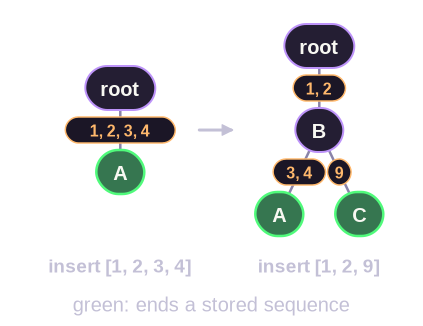
Sequences can be long (thousands of integers) and share long prefixes.
⭐ Bonus: a speed test with 2,000 sequences of 2,300 integers earns a star if insert and contains cost about O(len(seq)) (plus the size of any label you split), not O(total stored).
Show hint
Store at each node children: dict[first_int -> child], and at each child its label (a tuple or list) and an end flag. To insert, walk down; at a child, measure how much of its label matches the rest of seq. Full match: descend. Partial match of length c: split the child into a new middle node with label[:c], whose child is the old node with label[c:]; then either mark the middle as end or hang a new leaf off it.